
AI Receptionist Security: What Businesses Should Know Before Putting AI on the Phone

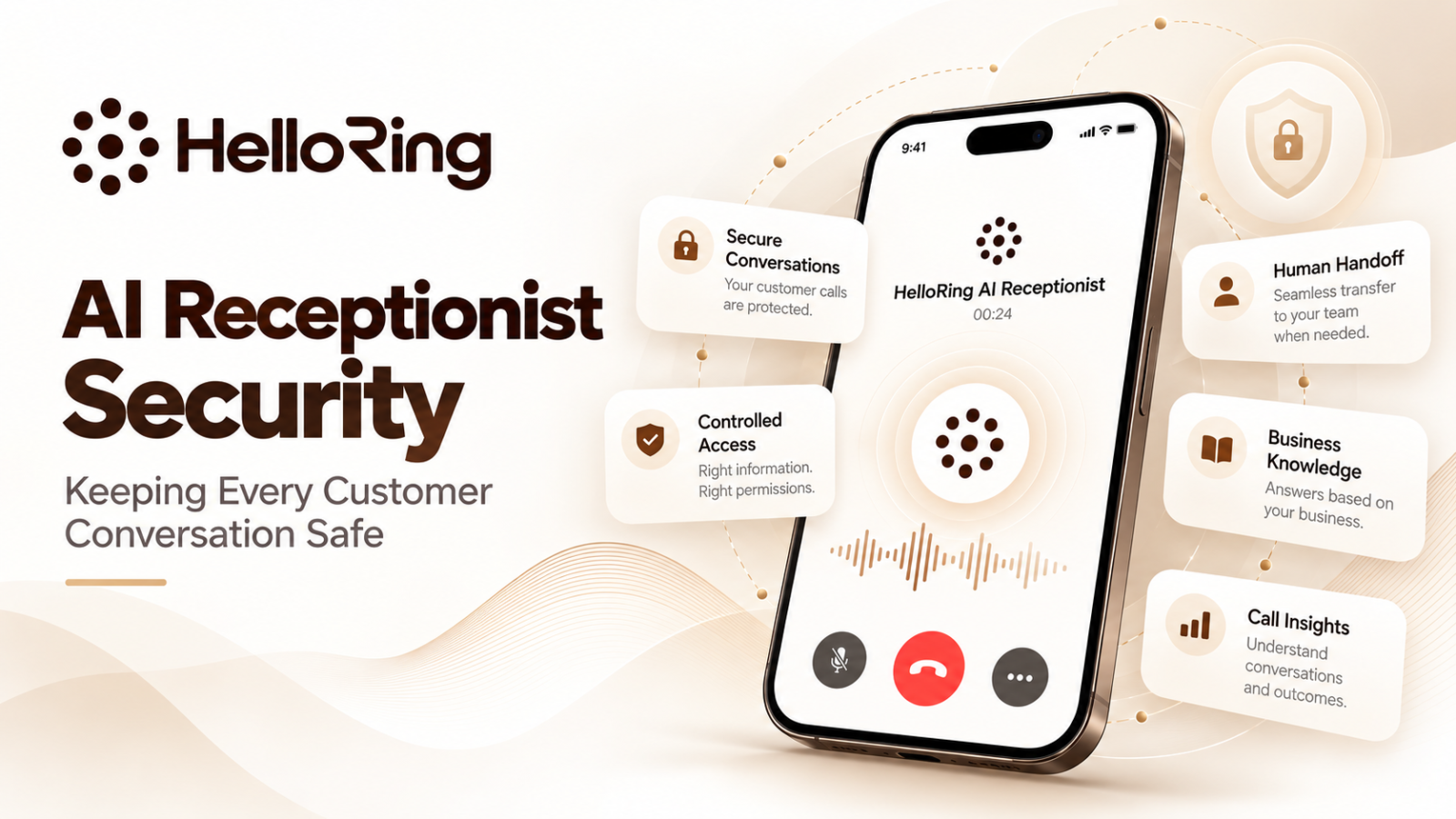
AI is changing the way businesses communicate with their customers.
From answering incoming calls to capturing leads, scheduling appointments, answering frequently asked questions, and routing customers to the right person, AI receptionists can now handle many of the conversations that traditionally required a human receptionist.
But as businesses begin putting AI on their phone lines, another question becomes increasingly important:
How secure is an AI receptionist?
A phone conversation can contain much more than a simple question. Customers may share their names, phone numbers, appointment details, business requirements, account information, or other personal information during a call.
That makes security an important part of choosing an AI receptionist.
For businesses, the goal isn’t simply to find an AI that sounds human. The right solution needs to be reliable, controlled, transparent, and designed around the way real customer conversations happen.
With HelloRing, the idea is simple: help businesses stay available for their customers while making AI-powered conversations useful, controlled, and easy to manage.
Why Security Matters for AI Receptionists
A traditional receptionist answers a phone call and communicates directly with the customer.
An AI receptionist can do much more.
It can understand what a caller is asking, provide information, collect details, qualify a lead, help schedule an appointment, and determine when a customer needs to speak with a human.
That means an AI receptionist is becoming part of the customer journey.
And whenever technology becomes part of that journey, businesses need to think about how information is handled.
Imagine a customer calling a business and saying that they want to schedule an appointment. During the conversation, they may provide their name, contact information, preferred time, and details about what they need.
The AI needs to understand the conversation and use the information appropriately to complete the task.
This is why AI receptionist security isn’t just about protecting a database.
It is about thinking carefully about the entire conversation, from the moment a customer calls to what happens after the call ends.
What Happens During an AI-Powered Call?
From the customer’s perspective, an AI receptionist can feel like a simple phone conversation.
Behind that conversation, however, several things happen.
First, the customer calls the business and the AI receptionist answers the phone.
The AI then listens to the caller and understands the intent behind the conversation. Instead of forcing the customer through a long list of keypad options, the caller can explain what they need naturally.
For example, a customer might say:
“I’d like to know more about your services and book an appointment for next week.”
The AI can understand that the caller has two requirements: they want information and they want to schedule an appointment.
From there, the receptionist can provide the relevant information, collect the necessary details, and help move the conversation toward the next step.
If the conversation requires human involvement, the AI can also hand the caller over to a team member.
The result is a customer conversation that can move from question to answer to action without requiring someone from the business to manually manage every step.
AI Receptionist Security Is More Than Data Protection
When businesses hear the word security, they often think about passwords, encryption, or databases.
Those things matter.
But AI receptionist security goes further.
Businesses should also understand what information the AI has access to, what the AI is allowed to do, and how the AI behaves when it doesn’t have enough information to answer a question.
An AI receptionist shouldn’t simply have unlimited access to everything inside a business.
Instead, it should operate within clearly defined boundaries.
The business should determine what the AI knows, what information it can provide, what tasks it can perform, and when it should involve a human.
This creates a more predictable customer experience and reduces the risk of an AI attempting to handle something outside its intended role.
Give AI the Right Information
For an AI receptionist to be useful, it needs to understand the business.
That may include information such as services, business hours, frequently asked questions, appointment availability, contact information, and other information that customers commonly ask about.
But providing information to an AI doesn’t mean giving it access to everything.
A well-designed AI receptionist should receive the information necessary for its role.
For example, if a customer asks about business hours, the AI should be able to provide the correct answer.
If a customer wants to schedule an appointment, the AI should follow the business’s defined appointment process.
If a caller asks something outside the AI’s knowledge, it should not invent an answer simply to keep the conversation going.
Knowing when to answer and knowing when to escalate are equally important.
What Can an AI Receptionist Actually Do?
Another important part of security is understanding what actions an AI is allowed to perform.
There is a difference between an AI giving information and an AI taking an action.
Answering a question such as “What time do you open?” is relatively straightforward.
Scheduling an appointment or transferring a caller involves an actual business action.
That is why businesses should define clear workflows for their AI receptionist.
The AI may be responsible for answering common questions, capturing leads, collecting basic information, assisting with appointments, and routing calls.
At the same time, there should be situations where the AI stops and involves a human.
The objective isn’t to make the AI do everything.
The objective is to make the AI do the right things.
Keeping Humans in the Loop
Automation doesn’t mean removing humans from customer communication.
Some conversations are simple and repetitive.
Others require experience, empathy, judgment, or access to information that only a human team member should handle.
For example, a customer might call and ask for the company’s opening hours.
That’s a straightforward conversation.
Another customer might call because they have an unresolved problem and want to speak directly with someone from the business.
That conversation may need a human.
A good AI receptionist should recognize this difference.
HelloRing is designed around the idea that AI can handle routine conversations while people remain available for the conversations that genuinely need them.
AI handles the routine. Your team handles what matters most.
Human Handoff Should Feel Natural
One of the biggest problems with traditional automated phone systems is that customers often have to repeat themselves.
They explain their problem to one system, get transferred to another person, and then have to start the entire conversation again.
That creates frustration.
A better AI receptionist experience should make the transition between AI and human as smooth as possible.
When a caller needs a person, the goal is to move the conversation forward rather than make the customer start over.
This is particularly important for businesses where customer context matters.
The AI should help the human team understand why the customer called and what has already been discussed.
Why AI Receptionists Can Improve Customer Availability
Consider what happens when a business doesn’t have someone available to answer the phone.
The customer calls.
Nobody answers.
They may leave a voicemail.
Or they may simply hang up and call another business.
For the customer, the experience is simple: they tried to reach the business and couldn’t.
An AI receptionist changes that experience.
The customer can call and receive an immediate response, even when the team is busy handling other work.
The AI can answer common questions, collect information, help with appointments, or route the call to the appropriate person.
This doesn’t mean every conversation needs to be automated.
It means fewer customer conversations have to end simply because nobody was available to pick up the phone.
What Should Businesses Look For in an AI Receptionist?
Choosing an AI receptionist should involve more than listening to a five-minute demo.
Businesses should consider how the system performs during real conversations.
The first thing to evaluate is conversational quality.
Does the AI understand natural language? Can customers speak normally instead of following a rigid script? Can the AI handle interruptions and follow the context of a conversation?
The second consideration is business knowledge.
Can the AI accurately answer questions about your company, services, hours, processes, and customer requirements?
The third consideration is human handoff.
Can the AI recognize when a conversation should be transferred to a person?
The fourth is integrations.
An AI receptionist becomes much more useful when it can fit into the existing workflows of a business, such as lead management, scheduling, CRM systems, or follow-up processes.
Finally, businesses should understand how the provider handles customer information and what security and privacy controls are available.
Don’t Choose an AI Receptionist Only Because It Sounds Human
A natural voice is important.
Nobody wants to speak with a robotic system that sounds like it is reading from a script.
But voice quality is only one part of the experience.
An AI receptionist can have a perfectly natural voice and still provide a poor customer experience if it doesn’t understand the caller, gives incorrect information, cannot handle interruptions, or doesn’t know when to transfer the call.
The real test is the complete conversation.
Can the AI listen?
Can it understand?
Can it respond?
Can it take the appropriate action?
And can it recognize when a human should take over?
That’s what makes an AI receptionist useful in the real world.
Building Trust Into Every Customer Conversation
Customers don’t need to understand the technology behind an AI receptionist.
They simply want their conversation to work.
They want an answer when they have a question.
They want help when they need something.
And they want to know that their request hasn’t disappeared into a system.
This is why transparency and consistency matter.
Businesses should be able to define how their AI receptionist introduces itself, what it can answer, what it should avoid, and when it should transfer a customer.
The AI should represent the business consistently across conversations.
That consistency can be particularly valuable for businesses that receive a high number of repetitive customer calls.
Instead of having employees repeatedly answer the same questions, the AI can provide the same business-approved information every time.
HelloRing: Your Business, Always Ready to Answer
Your customers don’t always call when your team is free.
They may call during a busy period.
They may call before your office opens.
They may call after the working day has ended.
And every unanswered call can potentially represent a customer, a lead, an appointment, or an important conversation.
HelloRing gives businesses an AI receptionist designed to stay ready to answer.
It can help businesses answer incoming calls, respond to customer questions, capture leads, assist with appointments, route callers, and support follow-up workflows.
Instead of forcing every customer conversation through voicemail or a rigid phone menu, HelloRing helps create a more natural first point of contact.
The goal isn’t to make your business feel automated.
The goal is to make your business feel available.
The Future of Business Communication Is Always-On
AI receptionists are changing the way businesses think about phone communication.
The question is no longer simply whether a business can automate its calls.
The better question is:
Which conversations should AI handle, and which conversations should remain human?
The answer will be different for every business.
But the direction is clear.
AI can take care of repetitive conversations, answer common questions, capture opportunities, and keep businesses available.
People can focus on complex situations, relationships, decisions, and conversations where human judgment matters.
The best results come when the two work together.
Final Thoughts
An AI receptionist should be more than a voice that answers the phone.
It should understand the business.
It should understand the customer.
It should operate within clearly defined boundaries.
It should know when to answer and when to ask for help.
And most importantly, it should make it easier for customers to reach the business.
That’s the idea behind HelloRing.
Your business, always ready to answer.
Because every call can be an opportunity.
Every conversation can matter.
And no customer should have to wonder whether anyone is there to answer.
Meet HelloRing — your AI receptionist for every customer conversation.