
What Is AI Cold Calling? How AI Is Changing Outbound Customer Conversations

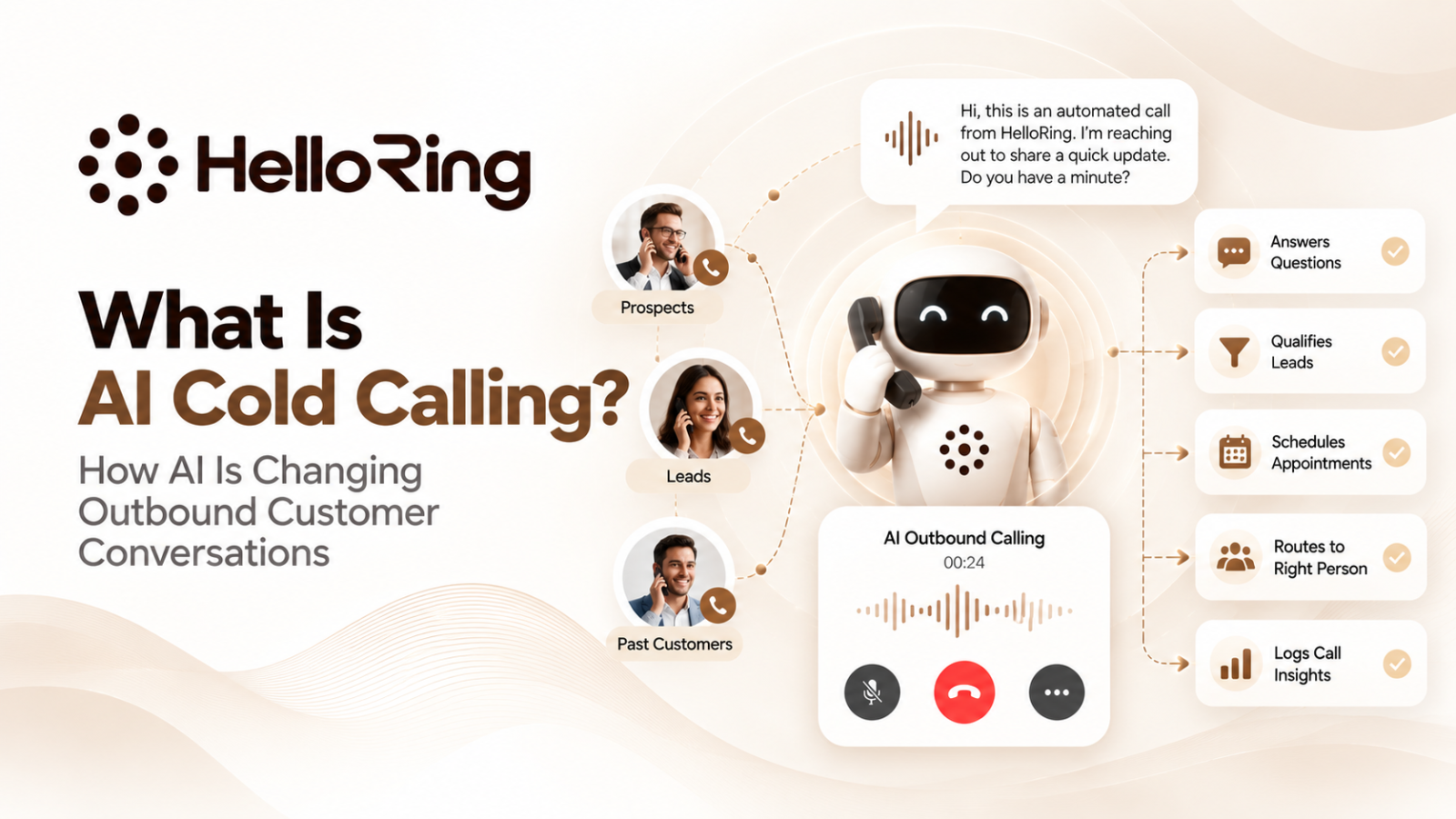
Understanding how AI-powered calling works, where it fits in modern sales, and how businesses can use voice AI more effectively
For years, cold calling has been one of the most common ways for businesses to reach potential customers.
A salesperson finds a prospect, picks up the phone, introduces the business, asks a few questions, handles objections, and tries to move the conversation toward a meeting or sale.
But traditional cold calling has a problem.
It takes time.
Sales teams can spend hours dialing numbers, waiting for answers, repeating introductions, leaving messages, and documenting the outcome of every conversation.
As businesses look for better ways to scale customer outreach, artificial intelligence is changing how phone conversations can work.
AI cold calling allows an AI voice agent to initiate outbound calls, have a real-time conversation with a prospect, understand responses, and follow a defined business objective.
But AI cold calling isn’t simply about making more calls.
The real opportunity is creating more intelligent conversations while allowing human sales teams to focus on the prospects and conversations that matter most.
What Is AI Cold Calling?
AI cold calling is the use of an AI-powered voice agent to make outbound phone calls to potential customers or leads.
Instead of playing a fixed recording, a conversational AI system can listen to what the person says, understand the context, and generate a response based on the conversation.
For example, an AI caller might contact a potential customer and say:
“Hi, I’m calling from ABC Business. I’m reaching out because you recently showed interest in our services. Do you have a minute?”
If the prospect responds:
“Yes, but I’m mainly interested in pricing.”
The AI can respond to that specific question instead of simply following a fixed script.
This is what separates conversational AI calling from traditional robocalling.
The goal is not just to play a message.
The goal is to have a conversation.
AI Cold Calling vs Traditional Cold Calling
Traditional cold calling depends heavily on human sales representatives.
A salesperson needs to:
- Find or receive a lead
- Dial the number
- Introduce the business
- Ask qualifying questions
- Handle responses
- Record the outcome
- Schedule follow-ups
- Update the CRM
When hundreds or thousands of leads are involved, this process can consume a significant amount of time.
AI can automate parts of this workflow.
An AI voice agent can initiate calls, have initial conversations, collect information, identify potential interest, and record outcomes according to the business workflow.
The difference can be summarized simply:
Traditional Cold Calling:
Lead → Salesperson → Conversation → Manual Notes → Follow-Up
AI Cold Calling:
Lead → AI Voice Agent → Conversation → Qualification → Workflow → Human Follow-Up
The human sales team can then spend more time on conversations that require experience, judgment, and relationship building.
How Does AI Cold Calling Work?
AI cold calling combines several technologies to create a real-time voice conversation.
The process generally begins with a list of leads or contacts that a business wants to reach.
The AI calling system then places an outbound call.
Once someone answers, the system listens to the person’s response, converts the speech into information the AI can understand, determines the appropriate response, generates an answer, and converts that answer back into natural-sounding speech.
This process happens continuously throughout the conversation.
The basic flow looks like this:
Outbound Call → Speech Recognition → AI Understanding → Response Generation → Voice Response
The conversation then continues until the objective is completed, the prospect ends the call, or the conversation needs to be transferred to a human.
The AI Needs More Than a Script
One of the biggest differences between traditional automated calling and modern AI calling is flexibility.
A traditional automated system might follow:
Question 1 → Answer → Question 2 → Answer → Question 3
But real conversations rarely work that way.
A prospect might interrupt.
They might ask a completely different question.
They might say they are busy.
They might ask for an email.
They might be interested but not ready to book a meeting.
A useful AI calling system needs to understand these variations rather than simply continuing through a fixed script.
The AI should have a clear objective, but the conversation should remain flexible enough to respond to what the prospect actually says.
What Can AI Cold Calling Be Used For?
AI cold calling isn’t limited to selling a product.
It can be used for many outbound business conversations.
Lead Qualification
An AI caller can contact potential customers and ask qualifying questions to determine whether a lead matches the business’s requirements.
Appointment Booking
When a prospect shows interest, the AI can help move the conversation toward scheduling an appointment or meeting.
Lead Follow-Up
Not every lead is ready to talk immediately.
AI can be used to follow up with leads who previously expressed interest but haven’t taken the next step.
Customer Reactivation
Businesses often have older leads or customers who haven’t interacted with them recently.
An outbound AI conversation can help re-engage those contacts where appropriate.
Reminders and Confirmations
AI calling can also support appointment reminders, confirmations, and other structured customer communications.
Surveys and Feedback
Businesses can use conversational voice AI to collect feedback without requiring employees to manually conduct every call.
The specific use case depends on the business, audience, consent requirements, and communication workflow.
Why Are Businesses Exploring AI Cold Calling?
The biggest reason is simple:
Scale.
A human salesperson can only make and manage a certain number of calls during a working day.
As the number of leads increases, businesses need either more people or better systems.
AI provides another option.
Instead of requiring a sales representative to manually handle every initial conversation, AI can take care of appropriate parts of the early outreach process.
This can help sales teams spend more time on:
- Qualified prospects
- Product demonstrations
- Complex questions
- Negotiations
- Relationship building
- Closing opportunities
The objective isn’t simply to increase the number of calls.
It’s to make the human sales team’s time more valuable.
AI Cold Calling Can Reduce Repetitive Sales Work
A large part of outbound sales involves repetitive activities.
Dialing.
Introducing the company.
Asking basic questions.
Repeating information.
Collecting contact details.
Recording outcomes.
Following up.
These activities are important, but they don’t always require a salesperson’s full attention.
AI can handle appropriate repetitive conversations while allowing sales representatives to focus on higher-value interactions.
This creates a different division of work.
AI handles scale.
Humans handle relationships.
What Makes an AI Caller Effective?
Making an AI sound like a person isn’t enough.
A useful AI caller needs to understand the purpose of the conversation.
Natural Conversation
The AI should be able to respond to what the prospect actually says instead of forcing every conversation through a rigid script.
Context Awareness
The system should understand the context of the conversation and avoid asking questions that have already been answered.
Interruption Handling
Real people interrupt each other.
An effective voice AI should be able to recognize interruptions and adjust the conversation instead of continuing to speak over the prospect.
Clear Objectives
Every outbound campaign should have a clear purpose.
For example:
Qualify the lead.
Book a meeting.
Confirm an appointment.
Collect feedback.
Without a clear objective, an AI conversation can become unnecessary or confusing.
Human Handoff
Not every conversation should remain with AI.
When a prospect is highly interested, asks a complex question, or needs personal assistance, there should be an appropriate path toward human involvement.
AI Cold Calling Shouldn’t Mean “Call Everyone”
One of the biggest mistakes businesses can make is treating AI calling as a simple volume game.
More calls don’t automatically mean more customers.
The quality of the contact list matters.
The relevance of the message matters.
The timing matters.
The conversation matters.
And most importantly, the business needs to respect applicable calling regulations and customer preferences.
A thoughtful AI calling strategy focuses on the right people, the right reason, and the right conversation.
Is AI Cold Calling Legal?
AI-powered outbound calling is subject to laws and regulations that vary depending on the country, the type of call, the recipient, and how the contact information was obtained.
Businesses should understand the rules that apply to their specific campaigns before making automated or AI-assisted calls.
Important considerations can include:
- Consent requirements
- Do-not-call restrictions
- Calling hours
- Caller identification
- Disclosure requirements
- Opt-out requests
- Recording and data requirements
- Industry-specific regulations
The rules can differ significantly between markets.
For that reason, businesses should not assume that a calling strategy that is acceptable in one location is automatically acceptable everywhere.
Responsible AI calling starts with responsible outreach.
AI Cold Calling and the Human Sales Team
There is a common fear that AI will completely replace salespeople.
But the more practical future is likely to be collaborative.
AI can handle the initial stages of an outbound conversation.
It can introduce the business.
It can ask qualifying questions.
It can identify interest.
It can collect information.
It can help schedule the next step.
Then a human salesperson can take over when the conversation becomes more valuable.
For example:
AI: “Are you currently looking for a solution for your customer calls?”
Prospect: “Yes. We’re actually evaluating a few options.”
AI: “I’d be happy to help arrange a conversation with our team. Would you prefer tomorrow morning or afternoon?”
The AI doesn’t have to close the deal.
It can simply help move the right conversation to the right person.
How AI Cold Calling Fits Into the Bigger Voice AI Revolution
AI cold calling is only one part of a much larger shift in business communication.
Businesses are increasingly using voice AI for both outbound and inbound conversations.
Outbound AI can help businesses reach customers.
Inbound AI can help businesses respond when customers call.
Together, these systems create a more connected communication experience.
The traditional model was:
Business → Customer
The emerging model is:
Business ↔ AI Voice Conversation ↔ Customer
The AI becomes another layer between the business and its customers, helping manage appropriate conversations at scale.
AI Receptionists and AI Cold Calling Serve Different Jobs
It’s important to understand the difference between these two use cases.
AI cold calling is primarily outbound.
The AI starts the conversation.
AI receptionists are primarily inbound.
The customer starts the conversation.
An AI receptionist answers when a customer calls the business. It can help with questions, lead capture, appointments, routing, and other customer-service conversations.
That’s where HelloRing fits.
HelloRing is designed around the idea that when customers reach your business, someone should be ready to answer.
HelloRing: Your Business, Always Ready to Answer
HelloRing is an AI receptionist built to help businesses handle incoming customer conversations.
Instead of allowing calls to go unanswered when the team is busy, unavailable, or outside normal working hours, HelloRing provides an AI-powered layer that can engage with customers.
It can help answer questions, capture leads, assist with appointments, and connect customers with the right person when human involvement is needed.
While AI cold calling focuses on starting conversations, HelloRing focuses on being ready when customers start them.
And both represent the same larger shift:
Business phone systems are becoming intelligent conversation systems.
The Future of AI-Powered Calling
The future of business calling isn’t simply about replacing a human voice with an artificial one.
It’s about creating better communication workflows.
AI can help businesses become more available.
It can help teams handle repetitive conversations.
It can help organize information from calls.
It can help identify opportunities.
And it can help connect customers with the right person at the right time.
But successful AI calling will always require more than technology.
Businesses need thoughtful workflows, clear objectives, responsible outreach, and appropriate human involvement.
The best AI isn’t the one that makes the most calls.
It’s the one that makes every conversation more useful.
Final Thoughts
AI cold calling is changing the traditional outbound sales model.
Instead of relying entirely on sales representatives to manually dial, qualify, document, and follow up with every lead, businesses can use AI to automate appropriate parts of the process.
At the same time, AI receptionists are changing the inbound side of business communication by helping companies answer and manage customer calls.
These technologies are different, but they are moving toward the same destination:
More intelligent business conversations.
For outbound teams, that can mean reaching and qualifying prospects more efficiently.
For businesses focused on customer experience, it can mean making sure incoming calls are handled when customers need help.
And for businesses using HelloRing, it means taking another step toward a simple idea:
Your business, always ready to answer.