
The Evolution of Business Communication: From Desk Phones to AI Receptionists

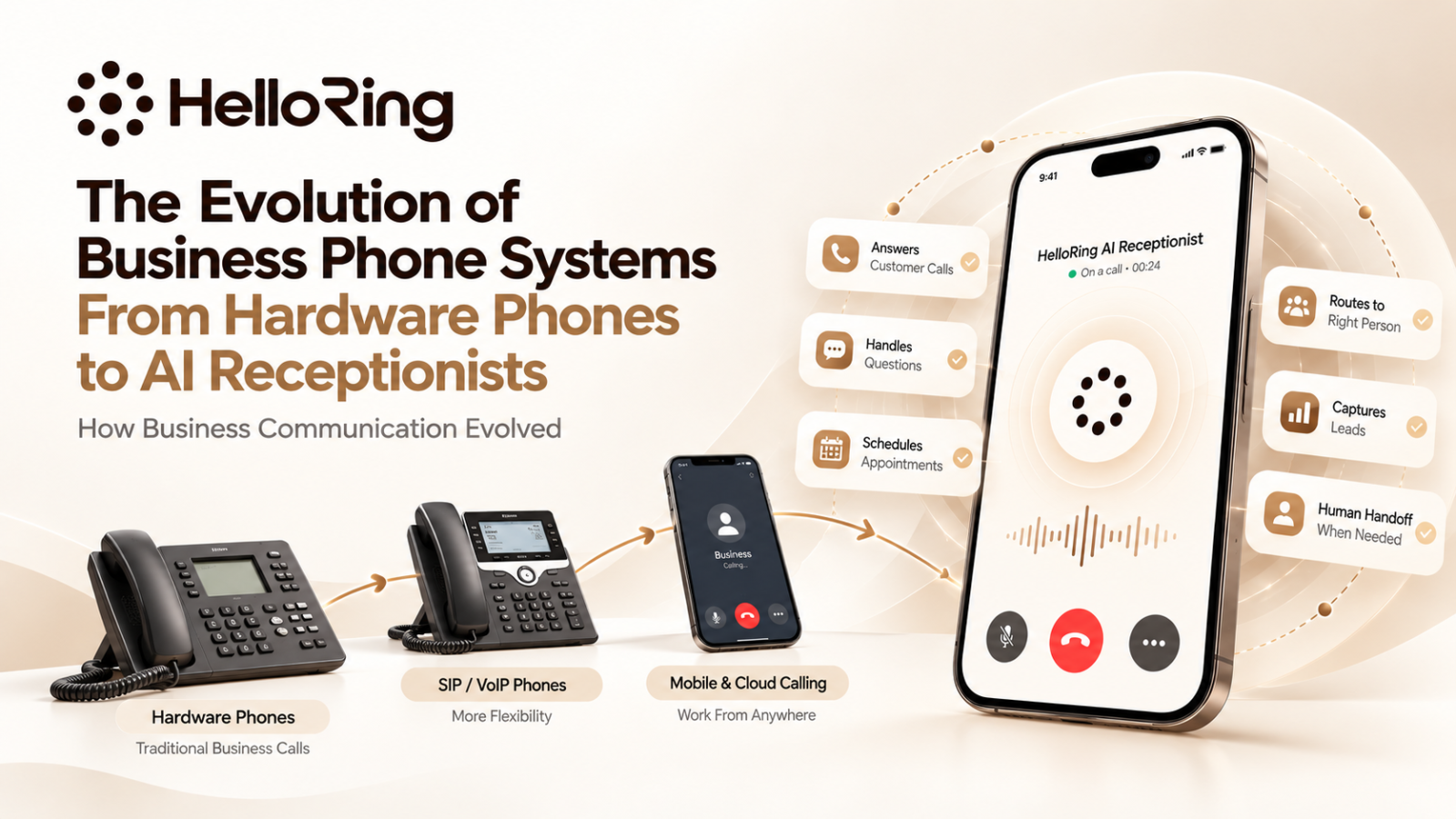
How businesses moved from traditional phone systems to always-on AI-powered customer conversations
There was a time when answering a business call meant being physically present at a desk.
A customer would call a business number, the phone would ring, and someone in the office would pick it up. If nobody was available, the customer had to wait, call again, leave a message, or move on.
Over the years, business communication has changed dramatically.
Traditional desk phones gave way to digital phone systems. Digital systems evolved into VoIP and cloud calling. Employees could eventually answer calls from computers and mobile devices instead of being tied to a physical desk.
And now, another major shift is happening.
The phone itself is becoming intelligent.
AI receptionists can answer calls, understand what customers are asking, provide information, capture leads, schedule appointments, and connect customers with the right person.
The evolution isn’t simply from one type of phone to another.
It’s the evolution from a phone that connects people to a system that can actually help customers.
What Is a Business Phone System?
At its simplest, a business phone system allows a company to make and receive calls.
But as businesses grew, simply having a phone number was no longer enough.
Companies needed extensions, call forwarding, voicemail, transfers, multiple lines, departments, and ways to route callers to the right person.
This led to increasingly sophisticated business communication systems.
The phone became more than a device for talking.
It became part of the way a business operated.
The Traditional Desk Phone
The earliest business communication systems were heavily dependent on physical hardware.
A phone sat on a desk.
A person sat near that phone.
When it rang, someone needed to physically answer it.
This worked well when businesses were smaller and teams were always in the office. But the limitations quickly became obvious.
If nobody was at the desk, the call could go unanswered.
If several customers called at the same time, someone might have to wait.
And if the business wanted to expand its phone system, additional hardware and infrastructure were often required.
The phone was useful, but it was still largely a passive communication tool.
It waited for someone to interact with it.
The Rise of Digital and VoIP Communication
The next major shift came when voice communication moved from traditional telephone infrastructure toward digital networks and the internet.
VoIP made it possible to transmit voice over internet connections instead of relying entirely on traditional phone infrastructure.
This changed the idea of what a business phone could be.
A phone number no longer had to be tied to one physical device.
Businesses could use digital phone systems, extensions, call forwarding, virtual numbers, and software-based calling.
Communication became more flexible.
Teams could work from different locations while still being connected to the same business phone system.
But there was still one important limitation.
The system still depended on a person to answer the conversation.
The technology could connect the call.
It couldn’t truly handle the conversation on its own.
When the Phone Became Software
As communication technology continued to evolve, the physical phone became less important.
A computer could become a phone.
A smartphone could become a business extension.
A browser could become a communication interface.
Instead of buying another physical device every time a company expanded, businesses could increasingly manage communication through software.
This created a much more flexible environment.
Employees could work from offices, homes, coworking spaces, or while traveling.
But there was still one important limitation.
The technology could connect the conversation, but a person still had to handle it.
When Communication Became Connected to Business
The next evolution wasn’t just about making calls easier.
It was about connecting calls with the rest of the business.
Phone systems increasingly became connected with tools such as CRM platforms, calendars, customer databases, helpdesk systems, lead management, and appointment scheduling.
A phone call could now become more than a conversation.
It could create a lead.
It could trigger a follow-up.
It could update customer information.
It could help schedule an appointment.
The phone was becoming part of the broader business workflow.
And that created the foundation for the next major change.
The Arrival of the AI Receptionist
This is where business communication starts to feel fundamentally different.
Instead of simply connecting a customer to an employee, an AI receptionist can participate in the conversation itself.
An AI receptionist can understand what a customer is asking and respond in real time.
For example, a customer might call a business and ask:
“Are you open tomorrow?”
The AI can answer.
The customer might then ask:
“Can I book an appointment around 3 PM?”
The AI can help with the next step.
The customer might have another question about the business.
The AI can continue the conversation instead of forcing the customer through a complicated menu.
This changes the role of the phone system.
It isn’t simply connecting calls anymore.
It is helping handle the customer journey.
From IVR Menus to Natural Conversations
Traditional automated phone systems often work through menus.
“Press 1 for sales.”
“Press 2 for support.”
“Press 3 for appointments.”
This can work for simple routing, but customers don’t always think in menu options.
They think in questions.
They might say:
“I want to know if you have an appointment available tomorrow afternoon.”
That’s a conversation, not a menu selection.
AI receptionists are designed around this conversational model.
Instead of asking customers to understand the company’s phone tree, the customer can simply explain what they need.
The AI can then determine the appropriate response or next step.
What Can an AI Receptionist Actually Do?
The biggest change isn’t simply that AI can answer a phone.
The bigger change is what can happen after the call is answered.
Answer Customer Questions
Customers can ask about services, availability, business information, processes, and other frequently asked questions.
Capture Leads
Instead of simply taking a message, an AI receptionist can collect important information from a potential customer.
Help With Appointments
An AI receptionist can assist customers with appointment-related conversations and help move them toward the next step.
Route Calls
Not every conversation should be handled by AI.
When a customer needs a specific team member, the conversation can be routed appropriately.
Handle Calls Beyond Business Hours
A business doesn’t necessarily stop receiving customer questions just because the office closes.
An AI receptionist can provide an additional layer of availability when the team isn’t available.
Provide Conversation Insights
Customer conversations can contain valuable information about questions, requirements, and outcomes. Organizing that information can help teams better understand what customers need.
The Biggest Change: From Availability to Always-On Availability
This may be the most important part of the evolution.
A traditional receptionist has working hours.
A traditional phone system has operating limitations.
An AI receptionist can provide another layer of availability.
A customer can call when the team is busy.
A potential lead can call outside normal office hours.
Someone may need a simple answer while the entire team is in a meeting.
Instead of every call competing for a person’s attention, AI can handle appropriate conversations and allow the team to focus on conversations that genuinely require human involvement.
The goal isn’t to replace every human conversation.
The goal is to make sure important conversations don’t get lost simply because nobody was available at that exact moment.
AI and Human Teams Work Better Together
The future of business communication isn’t necessarily AI versus humans.
It’s AI with humans.
AI can handle repetitive and straightforward conversations.
Humans can focus on situations that require judgment, empathy, expertise, or personal attention.
For example:
AI: Answers the incoming call.
AI: Understands why the customer is calling.
AI: Answers common questions.
AI: Collects relevant information.
AI: Handles the appropriate next step.
Human: Takes over when the situation requires personal assistance.
This creates a more practical model of customer communication.
AI handles availability and routine conversations.
People handle the conversations where people matter most.
What This Evolution Means for Businesses
The evolution of business communication isn’t really about replacing the old phone with a new phone.
It’s about changing what businesses expect from a phone system.
The traditional model was:
Customer → Phone → Employee
The modern model is becoming:
Customer → AI Receptionist → Business Workflow → Human Team
That additional intelligence can make a significant difference.
A call can become a lead.
A question can become an appointment.
A missed call can become a handled conversation.
And a conversation can become useful business information.
The Future of Business Communication Is Conversational
The next generation of business phone systems won’t simply be judged by how clearly they connect a call.
They’ll be judged by what happens during the conversation.
Can the system understand the customer?
Can it provide useful answers?
Can it access the right business information?
Can it take action?
Can it recognize when a human is needed?
Can it make the customer’s experience feel simple?
These are the questions that will define the next generation of business communication.
The evolution has already moved from hardware to software.
Now it’s moving from software to intelligence.
HelloRing: Your Business, Always Ready to Answer
HelloRing is built around this next step in the evolution of business communication.
Instead of treating your business phone as simply a number that rings, HelloRing turns it into an AI-powered receptionist designed to help manage customer conversations.
It can answer calls, respond to customer questions, capture leads, assist with appointments, and route customers to the appropriate team member when needed.
The idea is simple:
Your business shouldn’t stop being available just because your team is busy.
With HelloRing, your phone becomes more than a communication tool.
It becomes another part of your customer experience.
From Desk Phones to AI Receptionists
The evolution of business communication can be summarized simply:
Desk Phones → Digital Phone Systems → VoIP → Software & Cloud Calling → Connected Business Workflows → AI Receptionists
Each step made business communication more flexible.
But AI introduces something different.
Earlier technologies made it easier for people to communicate.
AI receptionists make it possible for business systems to participate in the communication themselves.
And that opens the door to a very different future.
A future where every customer call can be answered.
Every conversation can have a purpose.
And every business can be ready when its customers reach out.
That’s the evolution of the business phone.
And HelloRing is built for what comes next.
Frequently Asked Questions
What is an AI receptionist?
An AI receptionist is an AI-powered system that can answer business phone calls and interact with customers through natural conversations. Depending on its setup, it can answer questions, capture information, help with appointments, route calls, and perform other customer-service tasks.
How is an AI receptionist different from an IVR?
Traditional IVR systems generally guide customers through predefined menu options. An AI receptionist is designed to understand natural-language requests and respond conversationally rather than requiring customers to navigate a fixed menu.
Can an AI receptionist replace a human receptionist?
An AI receptionist doesn’t have to replace a human receptionist. It can work alongside a team by handling routine conversations, answering common questions, capturing leads, and providing availability while humans handle situations that require personal attention.
Can an AI receptionist answer calls outside business hours?
Yes. One of the key benefits of an AI receptionist is that it can provide an additional layer of availability beyond normal business hours, depending on how the business configures its system.
What can HelloRing do?
HelloRing is designed to help businesses answer customer calls, handle common questions, capture leads, assist with appointments, and route customers to the appropriate team member when needed.
Why are businesses moving toward AI-powered phone systems?
Because customer communication is increasingly expected to be fast and available. AI can help businesses handle more conversations without requiring a team member to manually answer every call, while allowing human employees to focus on higher-value interactions.